Friday, 17 April 2015

Georgiana's traits: Politics

https://houseswithhistory.files.wordpress.com/2012/05/g-2.jpg

Research taken from: Amanda Foreman - Georgiana Duchess of Devonshire

Newspapers would often give full detail of what Georgiana wore, her every activity and of her passion for Whig politics.  Like her friend Marie Antoinette had done in France, Georgiana made fashionable in London the completely outrageous three-foot pompadours. With horse hair put beneath her own, Georgiana’s hair was so tall the only way to ride in a carriage was to sit on the floor, quite a feat given her wide skirts. Because of her close friendship with Charles Fox leader of the whig party, there were rumours that he became Georgiana’s lover, but there is no evidence of this, nor is there evidence that she was lover to the Prince of Wales, as was her friend Lady Melbourne, whose son George was said to have been fathered by the prince.Before her time, Georgiana led an arduous door-to-door campaign in the Westminster election of 1784 and is credited with helping Fox and Lord Hood gain victory.  As the opposition party, the Whigs dressed in the blue and buff colors of the American rebels and carried fox tails–a manner of dress Georgiana was only too happy to adopt. Her canvassing resulted in a flagrant political rumors and satirical cartoons that implied she exchanged sexual favors and money for votes.  Despite her mother pleading to quit politics to shield her from public ridicule, Georgiana determined that the Whig’s could not win without her notoriety. Georgiana refused to stay in her carriage, instead walked the streets and faced commoners as an equal.

Georgiana's traits: Gambling

https://houseswithhistory.files.wordpress.com/2012/05/georgianna.jpg

Information taken from: Georgiana Duchess of Devonshire by Amanda Foreman

Georgiana launched into London society regardless and due to her high rank, enormous fortune and youthful beauty, she caught the public’s imagination. A celebrated beauty, Georgiana was constantly written about in the newspapers and her sense of style was reported with great interest.  Yet her true passion was gambling.  Gambling parties were all the rage and although Georgiana was technically wealthy, her husband controlled the family finances, giving her only an allowance. When her debts exceeded the generous four-thousand pounds annually given to her by the duke, her mother never failed to admonish her for her gambling debts.  “Play at whist, commerce, backgammon, trictrac or chess,” Lady Spencer wrote, “but never at quinze, lou, brag, faro, hazard or any games of chance.” The advice went unheeded.Despite that she was married to one of the wealthiest men in the kingdom, she was constantly borrowing money from her friends, from the Prince of Wales, and would flatter the wealthy banker Thomas Coutts with her friendship in exchange for him settling some of her debts. Constantly strapped for cash, her addiction to gambling threatened to bring shame on her and when she was died at age of 48, the Duchess was deeply in debt owing in today’s equivalent of £3,720,000.  The Duchess hid her debts from her husband until after her death, where upon he remarked, and “Is that all”? 
The Duchess anonymously published an autobiographical novel titled “The Sylph”, which was a success, going into four printings. Though she never publicly acknowledging her authorship, Georgiana did admit it in private. The book was a thinly veiled autobiography about an aristocratic bride seduced into wickedness and was written during one of her many attempts at reform from gambling and her fast lifestyle in public and in private.

Georgiana's traits: Lust and Love

https://houseswithhistory.files.wordpress.com/2012/05/georgianna.jpg

Research taken from: Georgiana the Duchess of Devonshire by Amanda Foreman

On the morning of the 7th June 1774, the 17 year old bride and the 26 year old bridegroom, together with the only five guests invited - Lord Richard Cavendish, the Duke's brother, Dorothy, Duchess of Portland, their sister, Lord and Lady Spencer, and Lady Cowper, Georgiana's grandmother - made their way to Wimbledon Park. In the parish church there, the ceremony was conducted. The bride wore a white and gold dress (of which we sadly have no pictures) and silver sleepers. Her hair was adorned with pearl drops. Her emotions could be seen on her face, while the Duke remained inscrutable as always. 

Unfortunately, the marriage was unhappy. Georgiana was too naive to realise that the Duke was as cold on the inside as he was on the outside and his infidelities certainly didn't help. Just shortly before their wedding, his mistress Charlotte Spencer, a milliner who wasn't related to his bride, had given birth to their baby daughter Charlotte.


From the start of their marriage, the duke preferred to spend his nights at Brook’s, playing cards until early in the morning.  Georgiana launched into London society regardless and due to her high rank, enormous fortune and youthful beauty, she caught the public’s imagination.
Despite that she was married to one of the wealthiest men in the kingdom, she was constantly borrowing money from her friends, from the Prince of Wales, and would flatter the wealthy banker Thomas Coutts with her friendship in exchange for him settling some of her debts.
Georgiana was responsible for providing an heir, which resulted in several miscarriages before giving birth to three children with her husband and an illegitimate daughter fathered by the 2nd Earl Grey.  She was also mother to the Duke’s illegitimate daughter, Charlotte.

Because of her close friendship with Charles Fox leader of the whigs party, there were rumors that he became Georgiana’s lover, but there is no evidence of this, nor is there evidence that she was lover to the Prince of Wales, as was her friend Lady Melbourne, whose son George was said to have been fathered by the prince.
Three years after Georgiana died the duke married Bess. Georgiana’s children were not happy and all three disliked Bess.  When Bess gloated about the duke giving his illegitimate daughter a larger dowry than his legitimate daughter Harryo, it was met with pride.

When Georgiana died, the most shocking reaction came from The Duke of Devonshire, who was inconsolable. In the final years of Georgiana's life the two had finally become close, and dare I say, even loving. Of course they would have their typical married-people bickering but it was if the calmer, more matronly Georgiana was the wife that Canis had always wanted. Her loss was a blow that the Duke, with his famous countenance, never really recovered from and put him in a sort of numb state until his own death. Guilt as well as the realization that Georgiana would not be holding his hand on his deathbed ate away at him. He locked himself in his room and then one night snapped. Bess stayed up all night with him and described the Duke as "hysterical." He never truly recovered from the blow.

Thursday, 16 April 2015

Associations of Georgiana

Lady Elizabeth Foster, later Duchess of Devonshire

In 1782, Bess met the Duke and Duchess of Devonshire in Bath. Seeing an opportunity to improve her circumstances, she attached herself to the emotionally-starved Duchess, with whom she formed an instant bond. She succeeded so well that when Georgiana went home, Bess was invited to accompany them. Eager to please, Bess provided the Duke with the companionship he needed and at some point became his mistress. After the birth of her son in 1790, Georgiana confessed her debts to the Duke. Bess stood by her throughout the ordeal. But the real test of her friendship came the following year when Georgiana was banished abroad because she was carrying Charles Grey’s child. Bess went with her. After two years abroad, the Duke relented, and Georgiana and Bess came home in the autumn of 1793. They resumed their strange ménage à trois, but Georgiana and the Duke were getting on much better than before, and Bess feared that her influence was waning.On 30 March 1806, Georgiana died. Bess was distraught. “She was the charm of my existence,” she wrote to her son, “my constant support in all my sorrows, the doubler and sharer of every joy.”
Georgiana had secured her friend’s immediate future by making her sole guardian of her papers. The Cavendish children might resent her presence, but the Duke found he could not do without Bess to look after him. Eventually, on 19 October 1809, the Duke and Bess were married. But Bess did not have long to enjoy the attainment of the position that she had coveted for so long. The Duke died on 29 July 1811, less than two years later. (http://www.regencyhistory.net/2012/10/lady-elizabeth-foster-later-duchess-of.html)


Charles James Fox 

Fox was the result of the scandalous elopement of Henry Fox, 1st Baron Holland the politician and Lady Caroline Lennox, one of the Lennox sisters, daughter of the Duke of Richmond. He and his brothers were raised in a libertine Whig household with little to no boundaries. Despite not inheriting a title, Fox became a favorite of his father and therefore extremely spoiled. There are stories of Fox burning his father's speeches and smashing his watch, with no consequences.

Fox grew into a fat macaroni, with a taste for gambling, politics, and women. He also liked fashion and in the macaroni tastes, powder his hair different colors every day and wear multi-colored shoes embellished with velvet frills. He was just plain outrageous! Fox began his career in parliament at the tender age of 19. Being a Whig, he tended to oppose anything the monarchy liked and vice-verse. He supported both the French and American revolutions. Despite his outrageousness, he was extremely well spoken and when he came into contact with Georgiana in 1777 a friendship bloomed that last until both their deaths in 1806. The two friends (and possibly lovers) found in each other a certain understanding and camaraderie that they couldn't find with others in their circle. Both were huge celebrities and common characters in political satires. For the Westminster election of 1784 Georgiana made history by being the first woman to canvass when she canvassed Fox.

Charles, 2nd Earl Grey

He was eldest surviving son of the first Earl Grey and educated at the best of schools, Eton, Trinity, etc. At the tender age of 22 he was elected to parliament. This was in 1786, two years after Georgiana had canvassed for Charles Fox and subsequently "retired" from politics. Upon being welcomed into the Whigs and of course the Devonshire House circle, he immediately latched on to Georgiana, 7 years his senior. She was flirtatious and welcoming with everybody, but he took her actions too seriously and became her shadow. This made Georgiana both nervous and enticed. Eventually Grey's violent declarations of love worked, and Georgiana began an affair. Love grew stronger and friends' well-meant advice was falling on deaf ears more and more frequently. Like a high school romance, he would argue with her if he felt she was paying more attention to other members of the circle. The lovebirds let their affair get out of hand when, Georgiana was staying in Bath by herself and Grey would be seen going in and out of her house with no discrepancy. When her mother, Lady Spencer heard this she furiously wrote and put a stop to their brashness. But it was too late, the damage was done. Georgiana was pregnant. Someone tipped the Duke of Devonshire off and he arrived unexpected to his 6-month pregnant wife in Bath. Screaming, crying commenced, followed by Bess being called into the room, and then scolding, and more screaming and crying. Harriet, Georgiana's sister sat outside hearing everything and recorded that she had never been so frightened. Georgiana was forced to leave the country. The Duke was humiliated and he gave her a choice: give the child up for adoption and never see Grey again or be divorced and never see her 3 children again. It wasn't much of a choice, but Grey still resented her for not choosing a fallen life with him. The relationship disintegrated after that. "I have in leaving him for ever, left my heart and soul; but it is over now...he has one consolation that I have given him up to my children only." Georgiana wrote in her grief. On February 20, 1791 Eliza Courtney was born and immediately taken from her mother's arms. Three years later Grey was engaged to Mary Ponsonby. He apparently couldn't bring himself to tell Georgiana himself, he waited until she read it in the papers. She was stricken speechless with grief. The married couple had 15 children in total but that didn't stop Grey from having an affair with Richard Sheridan's second wife Hecca. He went on to outlive Georgiana by many years and become Prime Minister under William IV. However he may still be known and recognised within the modern day society as the man who brewed and essentially created Earl Grey Tea!!! 


Marie Antoinette

Marie Antoinette, Queen of France, and Georgiana Cavendish nee Spencer, Duchess of Devonshire were two of the most famous women of the 18th century. When the Duchess visited France and met the Queen, the two women discovered they had a lot in common and became life long friends. Both Marie Antoinette and Georgiana loved gambling. They would spend entire nights at the gaming table, gambling away enormous fortunes and piling up huge debts. Their husbands weren't happy about it. The economical situation in France was disastrous and so Louis XVI forbade his wife from gambling. He granted her permission to play one last time, though, and the game went on for three days! Louis was disgusted. Georgiana instead, never stopped. Both women became fashion icons and trendsetters. Women would wait to see what clothes and hairstyles these two fashionable women, who had exquisite but also extravagant tastes, would wear so that they could imitate them. It was Georgiana who first wore big ostrich feathers on her hair and pretty soon, all the ladies followed suit, to some ridiculous extents at times.As Queen of France, Marie Antoinette was required to wear elaborate court gowns, although she preferred to switch to simpler styles of clothing when possible (in any case, both got her in trouble).Her fashion choices often had a political message like the ship ornament she wore in her hair to show her support to the Americans revolutionaries.Even though overtime the couples grew closer (Marie Antoinette refused to leave her husband during the French Revolution and William was said to be completely devastated when Georgiana died), both women were trapped in a loveless marriage. In addition, they hadn't just married a man, they had a married a position and had to deal with all the expectations, restrictions and duties their status imposed upon them. 

Wednesday, 15 April 2015

sourcing models

From initial researching and planning, I have been able to identify the posibility of using 3 different models, regarding the 3 different traits of Georgianas life. I am looking for models that possess the classical english rose look, comprised of pale skin, flush cheeks and possibly prominent lips. Depending on the hair from the models will depend on the style and quantity of wigs made and is subject to change. After extensive advertising and reviewing I have identified 3 models which I believe would be suitable for my project;

Model 1: Emma Fellows, Graduate actor from AUB Alumni 2014. Emma is an accomplished actor and also model, and I believe her complexion along with facial bone structure may allow for her to play the role of a sophisticated yet more stern, political style character, based on Georgianas political life with the Whig party. Currently working in Newbury travel arrangements will have to be made with Emma.

Model 2: Bethan Gurr, currently studying Acting in her final year at AUB is also an accomplished actor and model, confident in front of the camera. She again possesses the English rose reference I am looking for, and I feel could play the Gambler within Georgiana well. Her darker hair (Unfortunately not in the image used) makes me feel comfortable with taking a wig slightly darker on her pale skin, knowing it will not be too harsh and destroy the Classical essence of the visual piece.


Model 3: Lauren Rownley, perhaps the less competent model of the three I have selected, is a final year Illustration student at AUB currently building her modelling portfolio. Lauren is focusing on fashion modelling and is confident in front of the camera. She has a very romantic look about her, potentially due to the headpiece included in the image below, however her complexion and also face shape will work perfectly within the project to represent Georgianas relationships throughout her life, interpreted through hair and makeup.


Saturday, 11 April 2015

Interpretations of Gambling

Definition of Gambling; take risky action in the hope of a desired result.
"he was gambling on the success of his satellite TV channel"
or;
play games of chance for money; bet.
"he gambles on football"

Black is the absence of color. Black is a mysterious color that is typically associated with the unknown or the negative. The color black represents strength, seriousness, power, and authority. Black is a formal, elegant, and prestigious color. Authoritative and powerful, the color black can evoke strong emotions and too much black can be overwhelming. In the west black also represents death and mourning.

Red is assertive, daring, determined, energetic, powerful, enthusiastic, impulsive, exciting, and aggressive. The color red is linked to the most primitive physical, emotional, and financial needs of survival and self-preservation.

The color gold is the color of extravagance, wealth, riches, and excess, and shares several of the same attributes of the color yellow. The color gold is a warm color that can be either bright and cheerful or somber and traditional. The color gold is cousin to the color yellow and the color brown, and is also associated with illumination, love, compassion, courage, passion, magic, and wisdom.

Gold is definitely the most definitive way to describe Georgianas gambling addiction. She was always seeing gold within her eyes, convincing herself she could keep on winning, but infact kept loosing her wealth! The way in which illumination is associated with gold, and the way she illuminated herself into believing she could keep gambling really reflects on the way in which her life ended and her debts were uncovered. Black also may represent the atmosphere of gambling in the 1700's where it was a very undercover sport as such, and took place behind closed doors amongst close friends and companions only. Below again are some images analysing existing examples of gambling/money etc.


The image above was based around a glamorous yet modern editorial on gambling. The model is wearing prominently red or black on the face, which is the main feature of the image even amongst the bright lights of todays casinos. The hair is set up high, echoing the clenching of the fists and large grin on the models face, representing high spirits. The image is using a colour palette I would expect and do think is potentially a cliche image. http://www.trendhunter.com/trends/nuit-blanche

The second image, again very modern, applies a slightly less obvious image of gambling (until you concentrate on the surrounding poker chips) The model is wearing an extravagant yet dark bird feather cape, which almost represents darkness and potentially failure. The gold hue of the image really focuses and brightens up the models face, drawing us there, and a subtle red glare of lipstick is then echoed through the golden glare on the image. Her facial expression represents determination, something I think Georgiana definitely would of also represented at the gambling table.


The final image is drawn from Diors 2012 campaign. The colour palette gold, red and black instantly associates with the properties I have identified for gambling. The way in which she is lying on the floor hand on head, and one on her lip echoes the motion of a loss I believe - almost the self questioning of 'what have i done?'. She looks dazed, looking directly into the cameras eyes as if she is unconscious or a subconscious. The styling and placement of black and red on the face again influences this decision, but I believe the lack of obvious casino or gambling material makes the image a lot more likeable (personal presence) and makes the image a lot more luxurious and sophisticated, a representation of Georgiana I would like to convey through my images. The chequered shapes on her clothing also suggest the connection perhaps with chequers or chess - games which in the 1800's would be an appropriate way to gamble without cards.


Interpretations of Politics

The definition of Political;
of or relating to the government or public affairs of a country.
"a period of political and economic stability" 

The definition of Politics;
he activities associated with the governance of a country or area, especially the debate between parties having power.
"the party quickly gained influence in French politics"

Grey is a cool, neutral, and balanced color. The color gray is an emotionless, moody color that is typically associated with meanings of dull, dirty, and dingy, as well as formal, conservative, and sophisticated.
The grey color affects the mind and body by causing unsettling feelings. Light grays are feminine in nature, while dark grays are masculine in nature

Silver is the color associated with meanings of industrial, sleek, high-tech, and modern, as well as ornate, glamourous, graceful, sophisticated, and elegant. Silver affects the mind and body as a conductor and communicator that aids in public speaking and eloquence. Traditionally gray-haired seniors are viewed as just being old, while the phrase silver-haired traditionally describes a distinguished individual who is aging gracefully. 

The general hue of silver and grey are very similar, however I believe the use of the colour silver is more fitting to what politics represented in the 1700's. Politics today would be seen I believe as grey and dull by many people, however in Georgiana's era politics was ever developing, new policy was always being discussed and campaigning was constant. Georgiana was a graceful female edition to this all mans world, bringing a new modern outlook onto womens rights, centuries before the suffragettes even emerged. Therefore I believe silver is the most appropriate colour to represent Georgiana's political life.

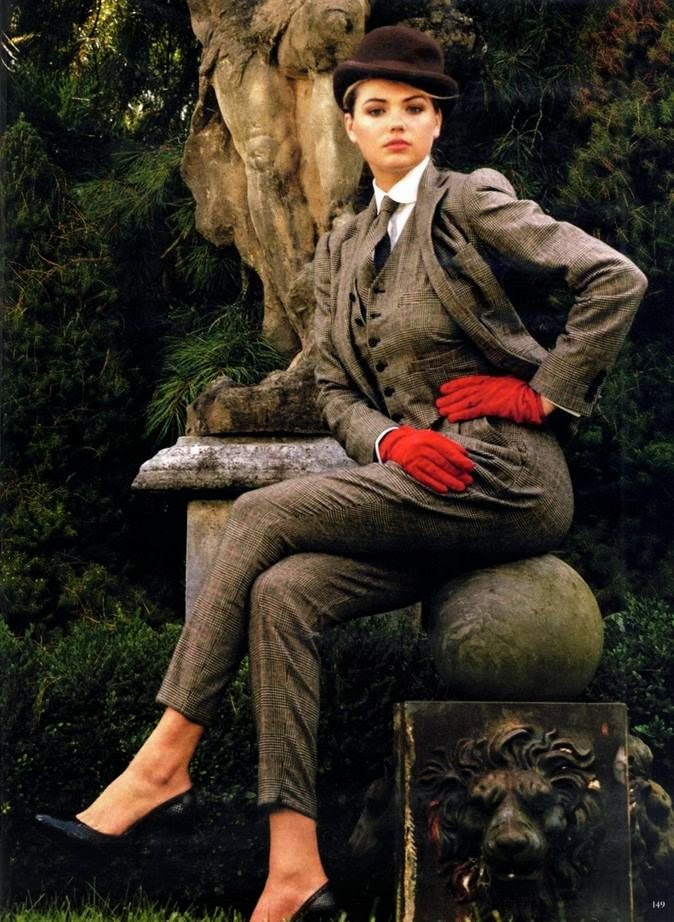
The first image I have chosen to analyse from Vogue Germany in 2012 focuses on the more masculine side of politics and the modern day perception of this. The full suited appearance obviously applies the male business attire of today and yesterdays societies. The placement of this on the female body is very powerful, and her poised positioning oozes confidence and knowledge, looking directly into the camera, giving the comfortable confident visuals we also saw in lust. The red gloves become the centre piece of the image and potentially represent a political party through this colour. This is echoed in the confident sultry red lips. This image however is not how Georgiana would of wished to be perceived as I believe she wanted it to be known she was a woman influencing politics rather than masking herself in mens attire to promote politics as this image could suggest. https://www.pinterest.com/pin/64176363412028162/

The image to the right looks at a more modern styling, bringing a classic 1700s styled dress into todays society, claiming the shape more as a long coat rather than a dress. The model also wears trousers created with newspaper - the headlines could potentially be comprised of political headlines which would really tie in with the project. This again could be coordinated into the headpiece on the top of the hair. The models hair is very large, something again which Georgiana would of championed, and also her make-up palette is subtle and sophisticated, which people throughout their professional side of life tend to follow a natural colour palette.
http://omghaute.com/b/v/mackenzie-foy-makes-her-beautiful-fashion-debut-for-magazine-lofficel/3174/#sthash.bjZmZYSq.dpbs


Interpretations of Love/Lust

Definition of love: a strong feeling of affection.
"babies fill parents with intense feelings of love"

Definition of Lust: strong sexual desire.
"he knew that his lust for her had returned"

Red, the color of blood and fire, is associated with meanings of love, passion, desire, heat, longing, lust, sexuality, sensitivity, romance, joy, strength, leadership, courage, vigor, willpower, rage, anger, danger, malice, wrath, stress, action, vibrance, radiance, and determination.

Both red and pink represent love. The color red represents heat and passion, while the color pink represents romance and charm. Hot pink is used to communicate playfulness, while light pink is used to communicate tenderness.

Pink, a delicate color that means sweet, nice, playful, cute, romantic, charming, feminine, and tenderness, is associated with bubble gum, flowers, babies, little girls, cotton candy, and sweetness.

Despite the fact Georgiana was a very lustful menacing woman, she also was very young when she married her Duke. Therefore investigating the colour pink, and how it associates with girls rather than  the intensity of red associated with women, would be an interesting idea to combine with the vision of love. Below are some images from fashion search engine trend hunter, which I have evaluated what messages they are giving off, through semiotic analysis. The images do not relate to the period or concept of my designs in any which way but are solely included for the analytical purpose of colour development;
The image to the left, taken from Latina Magazine in 2015 shows a woman being supported as she leans back onto a males arms. This suggests they are comfortable with each other. This idea is again moulded by the models bare skin being shaded in a mesh suit, covered in blue sequins/stones. This gives her almost a masculine association and makes me almost believe that as a strong woman she has fallen. The makeup is very simplistic yet the application of pink rather than red enables me to believe she is in a state of innocent 'love' rather than fiery 'lust' which red is more likely to represent. The hair is comprised of organic curled shapes, which is set back away from the face draping over the male's hand, making it a more innocent construction of the visual.
http://www.trendhunter.com/trends/love-lust


The image to the right taken from MAC's 2015 campaign 'Red' is clearly associated with the colour red for obvious marketing reasons, however the set up of the models poise and the set itself apply a more direct association to 'lust'. The set is all red, apart from a cushion, covered in oriental silk patterns, which link with the models ethnicity, and also the hue of red on this cushion pull in to the tone of red around the models eyes which is also identical - almost luring the audience into them. The models positioning ontop of the cushion looking directly into the eyes of the consumer, comfortably, almost makes us viewing the image on edge. The alluring setup as well as the models facial expression make the image seem relatively sinister, combined with the harsh deep red sharp shapes of the models clothing this visual seems far more likely to represent 'Lust' than 'Love'. http://www.trendhunter.com/trends/love-lust

The final image analysis, again taken from Trendhunter, uses the 
combination of Red and Black, as well as a natural green backdrop - a colour often associated with red to promote the colour. The model is shaded away from the camera and also from view, almost suggesting danger. Her lips coloured in red tie into the red of the skirt, which also promotes texture to the camera. Again the models eyes are looking directly at the camera, as if to intrude on her space like the image above, and her eyes are a piercing blue. Therefore I believe this image again promotes 'lust' via the sinister yet comfortable look in the models eyes, making the audience feel uncomfortable and intrusive. http://www.trendhunter.com/trends/love-lust
This basic study has enabled me to associate the visuals of love and lust further and will be developed more visually as the project goes on.

Friday, 10 April 2015

Tutorial with Sara (Friday 6th 2015)

Following a discussion with Sara on friday, I have been able to identify areas of study to research prior to design commencement and progression further into the project.

The book by Morag Martin - selling cosmetics in 18th century is a text that will allow me to visualise the selling style and semiotic context applied to people of the 1700's. 

I also should be trialling initial hair styles from the Keira Knightly film The Duchess prior to designing to get a feel for the shape and textures included within 18th century hair.
The Corson book will allow me to continue hair reasearch within the period and relate this to my characters. 

Looking at 18th century portrayal within our modern day society may also assist my understanding and conceptual ideas regarding my context and design ideas. Looking at the films listed below will allow me to do this;
- amadayus
- the affair of the necklace
- madness of george 4th
- marie antionette film

 Also researching the creative team from these films will benefit my understanding of ideas and process of ideas as well as the quality of work and specialism of the individual artists.

Tutorial with Carolyne (Tuesday 10th 2015)

Following a tutorial with Carolyne we have identified some key points within my design and project concepts which should be altered to fit the criteria required within the Major Project unit, and also to benefit my understanding and technical skills within my work;

Below is the tutorial sheet issued within the session;
After a small discussion about the PPP presentation, we then went on to discuss the use of one model, that would be beneficial to my project in making it clear i was representing the life of only one woman. We also discussed the idea of creating different techniques in wig making - not simply full wigs or cage wigs, but half wigs and even hair pieces/extensions to create length for a certain project. I explained that I wanted to use natural coloured hair for this, rather than coloured, as this is something I believe my portfolio would benefit from. We also discussed human hair and the face that my last project was limited thanks to the quality of the synthetic hair, and to really move my marks along human hair would be a beneficial material to work with in the project. My research was sparse and carolyne suggested beginning the design process asap as well as continuing to research the project so I can begin my practical side asap.

Thursday, 9 April 2015

Marie Antionette [DVD]

Having already discussed the definition of English and French hairstyles within my analysis of the affair of the necklace, I wanted to confirm this further by watching Marie Antionette, made in 2006. As a close friend of Georgiana I was hoping to see another visual alternative of the duchess, however was not able to.
The story of Marie Antoinette concerns the arranged marriage of the 14-year-old titular character (Dunst) of Austria to Prince Louis XVI (Schwartzman) of France to achieve peace between the two nations. After marrying, the French expected Louis and Marie Antoinette to produce an heir to the throne, but as the story unfolds we learn that Louis is not interested in sex, nor could Marie Antoinette seduce him enough to get interested. Louis XVI is a young man who is caught up in his own snobby life with more interest in hunting wild game than women. Queen Marie Antoinette doesn't fit in with the high-class lifestyle that the French royalty follows; she only wants to go to masquerade parties and sleep in each morning. Marie Antoinettetells the often comical and slightly entertaining story of these two together until the queen's eventual beheading.


 images from: http://www.firstshowing.net/2006/sofia-coppolas-marie-antoinette-review-extravagantly-boring/

The makeup in this film is much more appropriate to that of the duchess, with the flushed complexion and rouged cheeks. As both films are based on women of aristocracy as such, this is a more applicable vision, than that presented in The Affair of the Necklace, which was loosely based on Antoinette. The hair is no where near as large in the film as I had imagined it to be from visuals of the notorious 'boat hairpiece'. Research into the development of the height of french hairstyles will be an important part of the study as this was almost immediately undertaken by Georgiana before the rest of Britain followed.

The Affair of the Necklace [DVD]

In France 1767, a young girl watches in horror as soldiers of the reigning King Louis XV brutally seize her noble family's chateau. Orphaned and stripped of her royal heritage, young Jeanne Valois survives on her wits and her wiles, vowing to one day reclaim her birthright.  

Years later, still deeply committed to her quest, Jeanne (Swank) insinuates herself into the most illustrious court in all of Europe – Versailles. It is against this swirling, glamorous backdrop presided over by King Louis XVI and his extravagant and controversial wife, Marie Antoinette, that Jeanne risks her life to orchestrate an elaborate scheme of intrigue, romance and scandal revolving around the Queen and the world’s most spectacular diamond necklace. 


Images from: http://www.metroactive.com/papers/metro/12.06.01/necklace-0149.html

As the film is set in France and my project is very much influenced by british society in the 18th century, The referencing of hairstyles became important, so that I could define the differences between french and British styles. The lack of definition between curls and texture in the hair is something that definitely came to my attention. Makeup was very simplistic lacking the rouged cheeks of the makeup such as the Duchess. Analysis of Marie Antoinette as a character was something that also assisted me, having already discovered she was a very close friend of Georgiana's and also a fashion and hair influence.

The Duchess [DVD]

An extremely important part of my research into Georgiana was to watch the film The Duchess, set around the life of Georgiana. Although I understand a lot of the film may have been dramatically reinforced the basis of her life can never be fully understood, therefore resources such as films based upon a character are always of value during research. The drama has been adapted from Amanda Foreman's best-selling novel Georgiana, Duchess of Devonshire, documenting the romantic entanglements of Georgiana Cavendish (Keira Knightley), a beautiful and clever woman who becomes a celebrity of British high society when she marries the Duke of Devonshire (Ralph Fiennes) and becomes consort to one of the most powerful men in England. Beloved for her trend-setting fashion designs as well as her political activism, Georgiana's fire and wit make her a beloved figure everywhere but her own home, where her cold and distant husband's control over her is stifling, soon sending her into the arms of a another man -- an act that soon forces her to learn about the brutal difference in the rights afforded to 18th century men and women.
Images from: http://www.perioddramas.com/articles/the-duchess.php

 The plot of the film as mentioned briefly above is adapted from the biography of Georgiana by Amanda Foreman - perhaps the most accurate account of her life existing today. The makeup and hair styling within the film is appropriate to period in my visions, prior to more in-depth research into the era. The hair is notably taller, as always associated with the 18th century, and the makeup is almost always comprised of a light complexion with rouged cheeks and lips for women and a clean complexion for men. The lack of white powdered wigs within the film is something that surprised me as powdered wigs are something I personally heavily associate with the century, however I will research deeper into this. Overall the visual development of the 18th century has been helped by watching the film allowing me to also consider the costumes relevant to the era.


Wednesday, 8 April 2015

Model Quantity changes.

After consulting my tutors on the amount of models I am using, both expressed a concern in the bulk load of work I am taking on, as well as the interpretation of Georgiana as one person. After continuing my research into the project, and potentially the outcome I desire, I have been able to continue using just one model. I have chosen to use Lauren, who is local, and has a lot of promise as she is building her modelling portfolio, therefore I feel the dedication and effort towards my project lies with Lauren. She has the most competent and transferable look for all 3 aspects of the project and therefore is my final choice.


Meeting Model and Wig Fitting

Below are the images of the wig fitting on my model Lauren, a third year illustrator based at AUB, who is looking to build on her model portfolio. She has a very pale english rose complexion and natural hair colour which I believe is ideal for my concept.

 
 Lauren has thick hair which falls just below the shoulder. It is shorter than I had expected from images but is not necessarily a problem due to the fact the wigs can be made to extend length to her hair. I chose to wrap the hair this time with 4 plaits, which enabled me to get a smooth symmetrical wrap, without any unnatural bulks of hair.


 As seen in the images the wrap was very even and also tight at the nape of the neck, which is something very important to consider when wrapping the hair, so it will then be a tight fit when finished. Lauren's head measurements were also taken which are listed below;

Circumference of Head: - 56cm
Front to back of Head - 39cm
Temple to Temple (back of head) - 43cm
Ear to Ear (over crown) - 34cm
Nape of Neck - 9cm
Top of Ear - Nape - 10cm
Ear to Ear (over forehead) - 32cm
Temple to Temple (across face) - 18cm

As seen in the images Lauren has the English rose complexion I have been looking for whilst sourcing a model, including her natural tainted red lips seen in the image! I am looking forward to working with her to achieve the correct outcome for my FMP, styling her to fit the 3 sides of Georgiana I am creating.


An English Timeline of the 18th century

Below is a Generic timeline of the Georgian period (18th century) sourced from www.locaalhistories.org, looking at the relevant history of britain and the country in which Georgiana lived in.

1714 Queen Anne dies. George I becomes king
1715 The first Jacobite uprising. The Highlanders rise but the uprising ends in an indecisive battle near Stirling.
1719 Daniel Defoe publishes Robinson Crusoe
1720
The South Sea Bubble (stocks in the South Sea Company suddenly fall in price and many people lose huge sums of money.)
1721
Robert Walpole becomes the king's main minister. People call him the Prime Minister. (Originally it was a term of abuse).
1723 The great architect Christopher Wren dies.
1727
George I dies. George II becomes king.
Isaac Newton dies
1733 John Kay invents the flying shuttle
1735 The Prime Minister moves into 10 Downing Street
1739
The highwayman Dick Turpin is hanged
John Wesley founds the Methodists
1742 Prime Minister Robert Walpole resigns
1745 The second Jacobite uprising. The Jacobites invade England and reach as far as Derby but then turn back.
1746 The Jacobites are crushed at the battle of Culloden
1756 The Seven Years War against France begins
1759 General Wolfe captures Quebec but is killed. His victory ensures Canada will be a British colony not a French one.
1761 The Bridgwater canal opens
1763 The Seven Years War ends
1769 James Watt patents an improved steam engine
1771 Richard Arkwright introduces a loom powered by a water mill
1773 The Stock Exchange is founded
1775 Jane Austen is born
1779
The world's first iron bridge is built in Shropshire
Samuel Crompton invents the spinning mule
C. 1780
The Industrial Revolution begins to transform Britain
Lord George Gordon leads anti-Catholic riots in London
1783 Britain signs a treaty recognizing the independence of the American colonies
1784
Henry Cort invents the 'puddling' process. A new way of making wrought iron. As a result iron production booms.
1785
Edmund Cartwright invents the power loom (one worked by a steam engine). Cotton production grows very rapidly.
1787 The first convicts leave Britain from Portsmouth for Australia
1788 Lord Byron is born
1792 Gas light is invented
1796 Jenner invents vaccination against smallpox
1799 Income tax is introduced to pay for the war against France


Whilst researching into the general history of hair I was able to find a timeline relevant to that of hair in the book 'classical beauty'. This is an informative look at the way in which cosmetics developed throughout the era, as well as disease such as small pox, leaving women permanently scarred and developing new products to combat the appearance of them. Chemicals such as ground plaster were used in 1770 to create a new kind of lipstick for women, whereas in 1786 a large tax on cosmetics was set in britain, which effected the cost of most women, prompting home recipes to be followed at home and often resulting in dangerous chemicals again being applied onto the face.

Tuesday, 7 April 2015

18th century wigs [books]


Corson the first 500 years is an integral part of the learning process for majority if not all of my projects. At the begining of each century an introduction into the stylings of the hair in the era as well as the processes and symbolic styles are outlined. This can be seen to the right with an caricature of Mary Darly in 1777

Curls really reached the peak of wear at the beginning of the century, prior to the movement of taller wigs where women were described as '7 feet tall' and men often wondered 'will she cast off her head dress and surprise me with something?'.  The idea of the skirts and dresses becoming narrower towards the middle of the century and the hair becoming taller wider and more intricate

is what caricatures of Mary Darly (left and right) significantly represents. Women were often made fun of for their large wigs, however this was the idea of the females who wore the attention grabbing wigs. The products of powder were often used to replicate the expense of white hair and left the aristocrats with wigs full of dirt and often rats.

The history of hair continues this analysis of the hair, in a much shorter capacity, however an image of Georgiana with her daughter is included (see right)Her hair is referred to as 'the hedgehog style'.

It discusses the Americans adaptation of tall wigs almost a century after France first began the movement. Also discussed is Mary
Antoinette's hair which after childbirth thinned so much that

she began to adopt shorter styles, replicated by her servants and eventually the rest of Europe. Images again of the hair being powdered in large plumes can be seen.

The visual of the 18th century and the value of hair is very similar through each book providing a good level of research to

the project.

The encyclopaedia of hair discusses the shift in hair and the effects on culture more in-depth. The desire of lawyers, doctors and other such tradesmen to down their wigs and instead powder their own hair became a gesture of loyalty to their country after the dawn of the French Revolution. Women began replacing their

elaborate wigs with more subtle wigs, adorned with pins and combs rather than heavy expensive ornaments. The styles began to resemble that of the women in ancient greece (Also quoted by Corson.) The book also considers the references from different eras to that of the eighteenth century (left image). The comprehensive history of hair I have researched so far has enabled me to continue developing designs for the project, looking more at the techniques and styles relevant to period that can be referenced within my designs.